

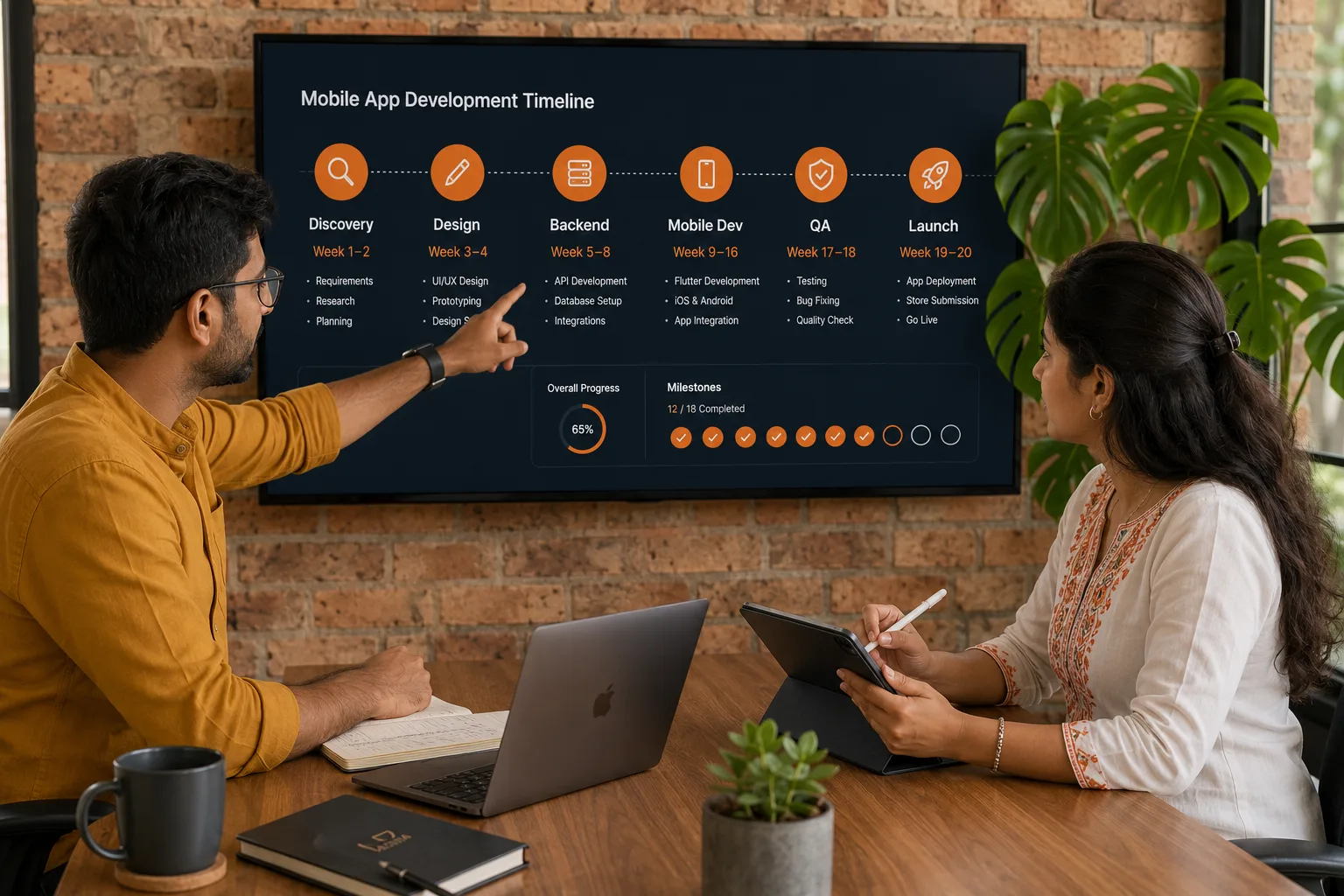

Why Mobile App Development Timelines Are Difficult to Estimate
Mobile app development timelines are notoriously difficult to estimate accurately — and agencies that give instant quotes without reviewing your requirements are either guessing or padding heavily to protect themselves.
The honest reason timelines vary is that two apps can look similar on the surface but require completely different engineering effort underneath. A food delivery app with real-time order tracking, driver location updates, payment processing, push notifications, and a restaurant management portal is fundamentally different from a simple menu browsing app — even though both might be described as “a food delivery app.”
This guide gives you realistic timeline ranges for different complexity levels, a phase-by-phase breakdown of where time actually goes, and the most common reasons mobile app development projects run over schedule.
Mobile App Development Timeline by Complexity
Simple Apps — 6 to 10 Weeks
Simple apps have a focused feature set — typically 5 to 10 screens, one or two user roles, minimal backend complexity, and no real-time features. Examples include:
- Information or content apps with static or semi-static data
- Simple booking or appointment tools with basic calendar functionality
- Internal team tools with straightforward CRUD operations
- MVP products designed to validate a single core idea quickly
At this complexity level, a well-scoped project with an experienced team can move from kick-off to App Store submission in 6 to 10 weeks. The variable is scope clarity — a simple app with vague requirements takes longer than a complex app with detailed specifications.
Mid-Complexity Apps — 3 to 5 Months
Mid-complexity apps form the majority of commercial mobile app development projects. These apps have multiple user roles, real-time features, third-party integrations, and backend systems that require meaningful engineering effort. Examples include:
- Marketplace and e-commerce platforms with buyer and seller flows
- On-demand service apps with real-time tracking and payment processing
- Social platforms with user profiles, content feeds, and messaging
- Fintech apps with transaction history, payment integration, and security requirements
- Healthcare apps with appointment booking, records management, and notification systems
Timeline range of 3 to 5 months assumes a fixed scope, experienced team, and no major requirement changes during development. The lower end applies to Flutter cross-platform builds; the upper end applies to separate native iOS and Android development.
Enterprise and Complex Apps — 6 to 12 Months
Enterprise apps involve complex data models, multiple system integrations, regulatory compliance requirements, high security standards, and often multiple interconnected platforms — mobile app, web dashboard, admin portal, and API layer. Examples include:
- Multi-tenant SaaS platforms with role-based access control
- Healthcare platforms with HL7 FHIR integration and HIPAA compliance
- Fintech platforms with PCI DSS compliance and core banking integration
- Logistics platforms with fleet management, route optimisation, and IoT integration
- AI-powered applications with custom model training and real-time inference
Timeline of 6 to 12 months reflects the genuine engineering complexity of these systems — not slow development, but the irreducible time required to build, test, and validate systems where errors have significant consequences.
Mobile App Development Timeline Phase by Phase
Phase 1 — Discovery and Specification (1 to 3 Weeks)
Discovery is the phase most clients want to skip and most experienced development teams insist on. This is where your idea becomes a buildable specification — user stories, feature lists, data models, third-party integration requirements, and acceptance criteria for every feature.
The time invested in discovery pays back in development. Projects with detailed specifications consistently deliver faster and closer to budget than projects that start development with vague requirements. Every hour spent clarifying requirements in discovery saves 3 to 5 hours of rework in development.
Phase 2 — UX and UI Design (2 to 5 Weeks)
Design covers information architecture, user flow mapping, wireframing, visual design, and prototype creation. For mid-complexity apps, expect 2 to 3 weeks for a skilled design team working at pace. Enterprise apps with complex workflows may require 4 to 5 weeks.
Design sign-off before development begins is critical. Changes to core user flows after development has started are expensive — a navigation change that takes 2 hours in a design file takes 2 to 3 days to implement and test in code.
Phase 3 — Backend Development (4 to 14 Weeks)
Backend development — database design, API architecture, business logic, third-party integrations, and infrastructure setup — is typically the longest phase and the most variable. Simple apps with minimal backend complexity can complete this phase in 4 to 6 weeks. Complex platforms with multiple integrations and high security requirements take 10 to 14 weeks.
Third-party integrations are the most common source of backend timeline overrun. Payment gateways, mapping APIs, push notification services, social login providers, and analytics platforms each require integration, testing, and error handling that adds time beyond the base estimate.
Phase 4 — Frontend and Mobile Development (4 to 12 Weeks)
Mobile development runs partially in parallel with backend development — UI components can be built before backend APIs are complete, using mock data. Full integration between frontend and backend typically happens in the final 2 to 3 weeks of this phase.
Flutter development compresses this phase significantly compared to separate native iOS and Android development. A single Flutter codebase eliminates the parallel development effort that doubles native development time.
Phase 5 — Testing and QA (2 to 4 Weeks)
Quality assurance covers functional testing, performance testing, security testing, device compatibility testing, and user acceptance testing. Rushing QA to meet a deadline is one of the most common causes of poor App Store ratings and post-launch emergency patches.
For apps handling payments, personal data, or healthcare information, security testing is non-negotiable and requires additional time beyond standard QA. Budget 3 to 4 weeks of QA for any app in these categories.
Phase 6 — App Store Submission and Launch (1 to 2 Weeks)
App Store submission involves preparing store listings, screenshots, privacy policy documentation, and compliance disclosures — then waiting for review. Apple’s review process takes 1 to 7 days for most apps. First-time submissions and apps using sensitive permissions or monetisation features take longer.
Always budget 2 weeks for the submission phase. Rejections requiring fixes and resubmission can add another week to the timeline, and this is not a phase where rushing is possible regardless of deadline pressure.
The Most Common Causes of Timeline Overrun
Scope changes mid-development — adding or changing features after development has started is the single most common cause of timeline overrun. Every scope change requires re-estimation, rework of existing code, and re-testing. A feature that would take 2 weeks if specified upfront takes 3 to 4 weeks when added mid-sprint.
Delayed client feedback — development teams typically need feedback within 24 to 48 hours of sharing design mockups, API specifications, or development builds. Delays in client feedback create idle time that compounds across the project timeline.
Third-party integration complexity — payment gateways, mapping services, and communication APIs are consistently more complex to integrate than their documentation suggests. Budget additional time for every significant third-party integration in your app.
Underestimated backend complexity — client-facing features look simple in wireframes but often require significant backend engineering. Real-time features, search functionality, recommendation systems, and complex permission models all require backend work that is invisible in the UI but substantial in development time.
How AZRIVA Manages Mobile App Timelines
Our mobile app development process is built around scope clarity and milestone accountability. Every project starts with a detailed discovery phase that produces a specification document both parties sign off before development begins. Milestones are tied to deliverables — not calendar dates — with payment released on delivery rather than on schedule.
We build iOS, Android, and Flutter apps for businesses across USA, UK, Canada, and India at a fixed price. Our IST timezone gives overseas clients meaningful daily overlap for standup calls, milestone reviews, and rapid feedback cycles that keep development moving without the communication delays that commonly inflate offshore project timelines.
If you are planning a mobile app project and want an honest timeline and fixed-price quote based on your specific requirements, our team will give you a realistic assessment within 48 hours.