WordPress vs Custom Website: Understanding the Core Difference
WordPress is a content management system — a pre-built platform that powers approximately 43% of all websites on the internet. It provides a database, an admin interface, a theme system, and a plugin ecosystem that extends its functionality. You install it, configure it, add plugins, and build your site within its constraints.
A custom website is built from scratch — or from a modern framework like Next.js, Astro, or Laravel — specifically for your business requirements. There is no pre-existing structure to work within. Every feature, every interaction, every data model is designed for your use case.
Both approaches can produce excellent websites. The question is which approach fits your business requirements, budget, and long-term goals — and that depends on factors most generic comparisons never address honestly.
WordPress vs Custom Website: Direct Comparison
Development Cost and Timeline
WordPress has a genuine cost advantage for standard requirements. A professional WordPress site — custom theme, standard plugins, content migration, basic SEO setup — can be delivered in 4–8 weeks at USD 3,000–15,000.
Custom website development starts higher and scales with complexity. A custom marketing site built on a modern framework typically costs USD 15,000–35,000. A custom web application — with user accounts, custom workflows, third-party integrations, and a bespoke CMS — typically costs USD 40,000–120,000+.
For businesses with standard requirements and limited budgets, WordPress delivers more website per dollar in the short term. For businesses where the website is a revenue-generating product, the custom development premium pays back through performance, reliability, and capability advantages.
India-based custom web development teams typically deliver custom websites at 40–60% lower cost than US or UK agencies — making custom development accessible at price points that were previously WordPress-only territory.
Performance and Core Web Vitals
This is where the gap between WordPress and custom development is most stark and most consequential.
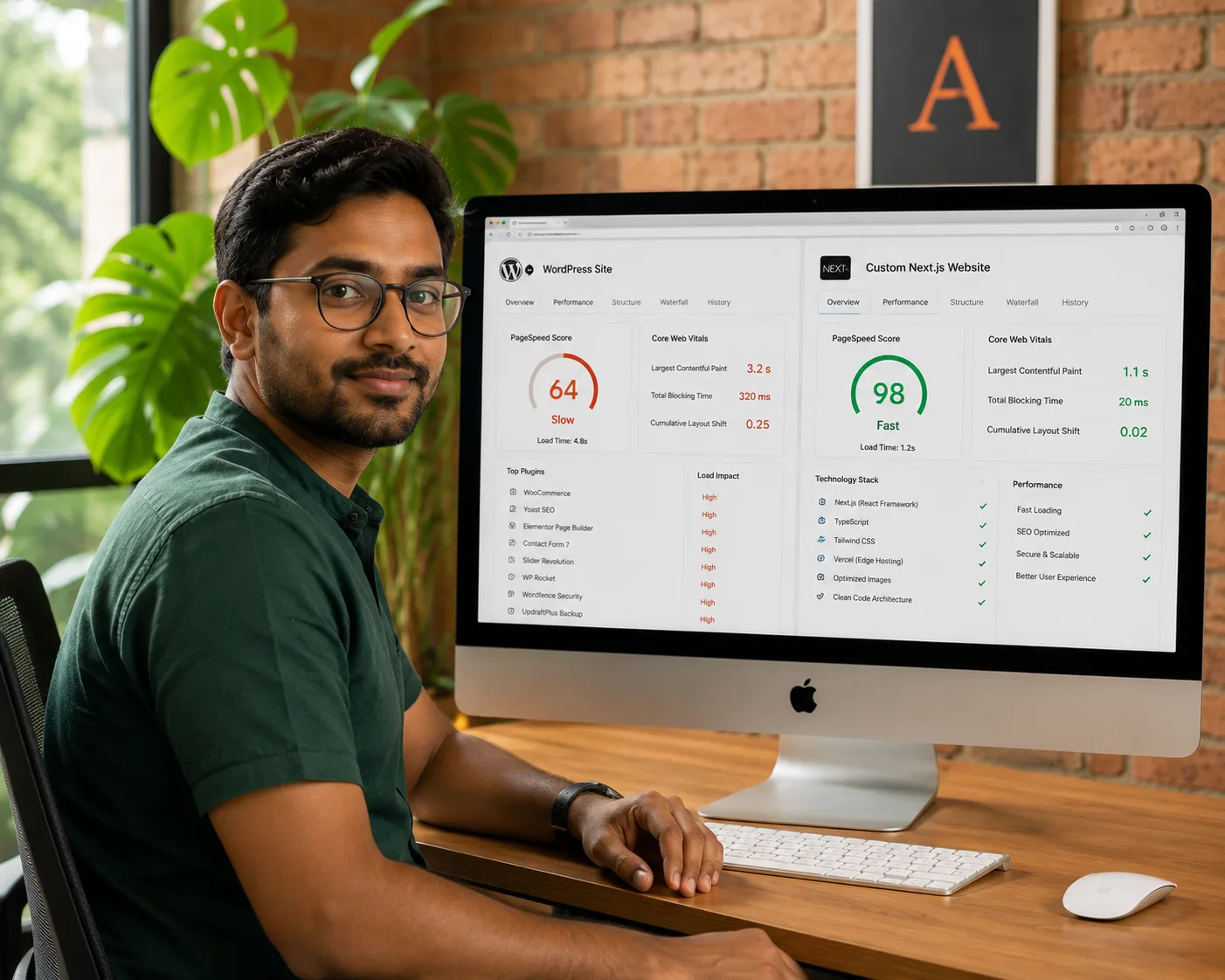
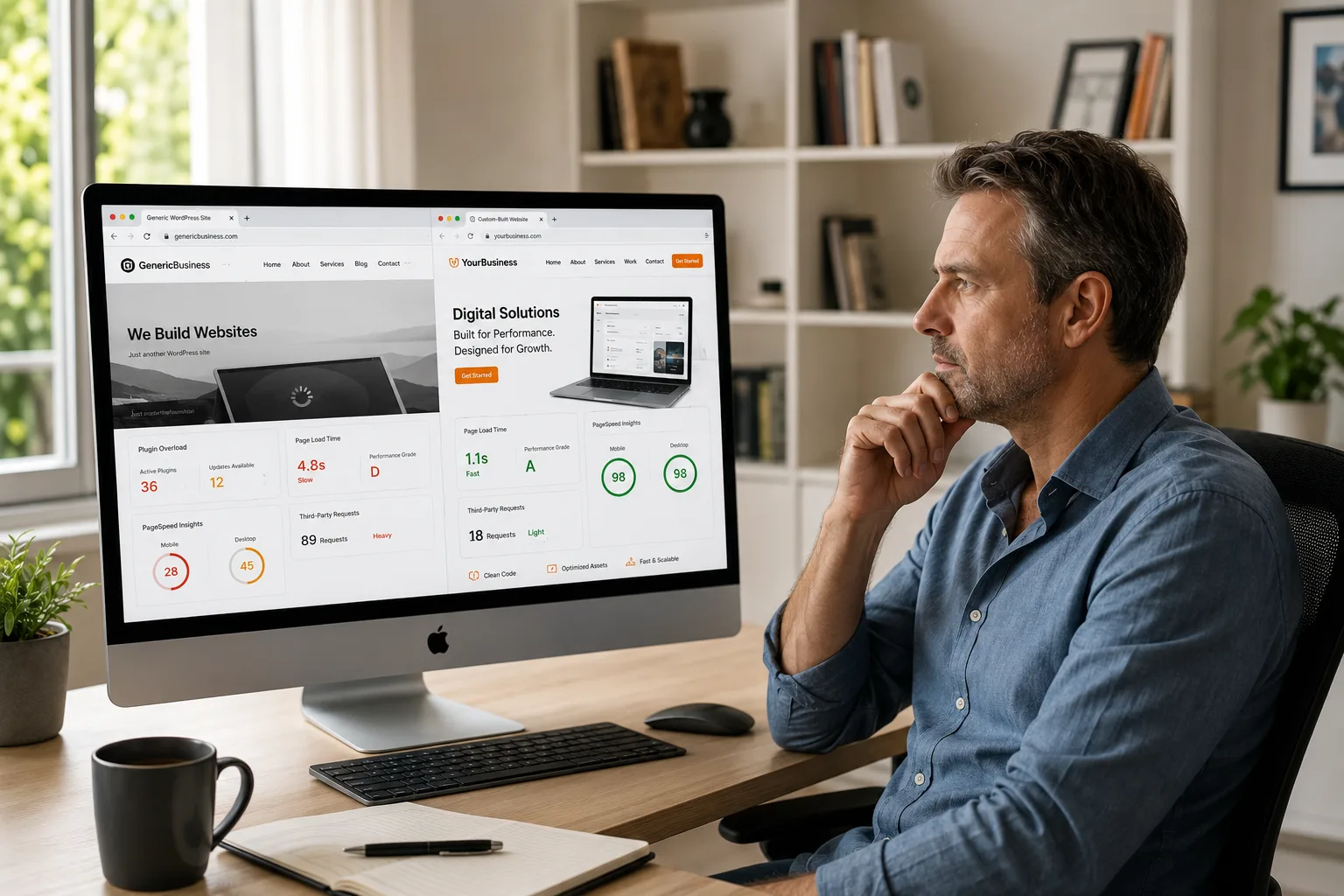
A default WordPress installation loads dozens of database queries, theme files, plugin scripts, and admin bar assets on every page request — most of which are irrelevant to what the visitor actually needs. Even with caching plugins, a typical WordPress site with 15–20 active plugins struggles to score above 75 on Google PageSpeed Insights.
A custom website built on a modern framework like Next.js or Astro generates static HTML at build time, serves it from a CDN, and loads zero unnecessary JavaScript. PageSpeed scores of 95–100 are routine, not exceptional.
This matters commercially because Google uses Core Web Vitals — loading performance, interactivity, and visual stability — as a ranking signal. A custom website that loads in 1.2 seconds will outrank a WordPress site that loads in 3.8 seconds, all else being equal. For businesses investing in SEO, performance is not a technical detail — it is a competitive advantage.
Flexibility and Custom Functionality
WordPress is highly flexible within its architecture — but its architecture has hard limits. Complex custom workflows, non-standard data models, real-time features, and deep third-party integrations consistently hit those limits. The typical response is more plugins — which adds more performance overhead, more security surface area, and more maintenance complexity.
Custom development has no architectural limits. If a feature can be built, it can be built exactly the way your business needs it. Custom pricing engines, dynamic product configurators, complex booking systems, multi-tenant SaaS platforms, and AI-powered features are all straightforward on a custom platform and genuinely difficult on WordPress.
Security and Maintenance
WordPress security is an ongoing operational requirement, not a one-time setup task. Core updates, plugin updates, theme updates, and security patches require regular attention. A WordPress site that is not actively maintained is a liability — outdated plugins are the primary attack vector for the majority of WordPress compromises.
Custom websites have a structurally smaller attack surface. There is no public-facing admin panel at a predictable URL. There are no third-party plugins with unknown security histories. There is no WordPress XML-RPC endpoint that brute-force attackers target by default.
Maintenance for custom websites is lower frequency but higher technical complexity — framework updates, dependency management, and infrastructure maintenance require developer involvement rather than a plugin update button.
Scalability
WordPress scales reasonably well with proper infrastructure — caching, CDN, database optimisation, and managed hosting can support significant traffic volumes. But WordPress was designed as a publishing platform, not a scalable application platform. At high traffic volumes or with complex data models, its database architecture becomes a bottleneck that requires increasingly expensive infrastructure to work around.
Custom websites built on modern frameworks are designed for scale from the ground up. Static generation, edge deployment, and API-first architecture means traffic spikes are handled at the infrastructure layer — not by throwing more compute at a monolithic PHP application.
When to Choose WordPress
WordPress is the right choice when:
- Your website is primarily a content and marketing channel — not a revenue-generating product
- Your requirements match standard WordPress functionality without significant custom development
- You need a non-technical team member to manage content independently after launch
- Your budget is below USD 15,000 and standard functionality covers your needs
- You need to launch quickly and standard templates are acceptable for your brand
When to Choose Custom Development
Custom development is the right choice when:
- Your website is a product — a platform, a marketplace, a SaaS application, or a web app
- You have specific performance requirements that WordPress cannot meet without extreme optimisation
- Your functionality requirements go beyond what plugins can deliver cleanly
- You need deep integration with third-party systems — ERPs, CRMs, payment platforms, or AI services
- You are building for long-term scale and do not want to migrate platforms in 3 years
- Brand differentiation and unique UX are competitive requirements for your business
The Hybrid Approach — Headless WordPress
A growing number of businesses use a headless WordPress architecture — WordPress as a content management backend, with a custom Next.js or Astro frontend consuming the WordPress REST API. This gives non-technical teams the familiar WordPress editing experience while delivering the performance and flexibility of a custom frontend.
Headless WordPress is worth considering when your content team is deeply invested in the WordPress editing workflow but your performance and design requirements exceed what a traditional WordPress theme can deliver.
What AZRIVA Builds
Our web development team builds custom websites and web applications on modern frameworks — Next.js, Astro, and React — for businesses across USA, UK, Canada, and India. Every project is delivered at a fixed price, with direct engineer access, and full source code ownership.
We also build mobile apps alongside web platforms — so if your business needs both a web presence and a mobile product, we can deliver both from a single team with a shared design system and consistent API architecture.
If you are deciding between WordPress and custom development for your next project, we will give you an honest assessment based on your specific requirements — and then build it at a fixed price.